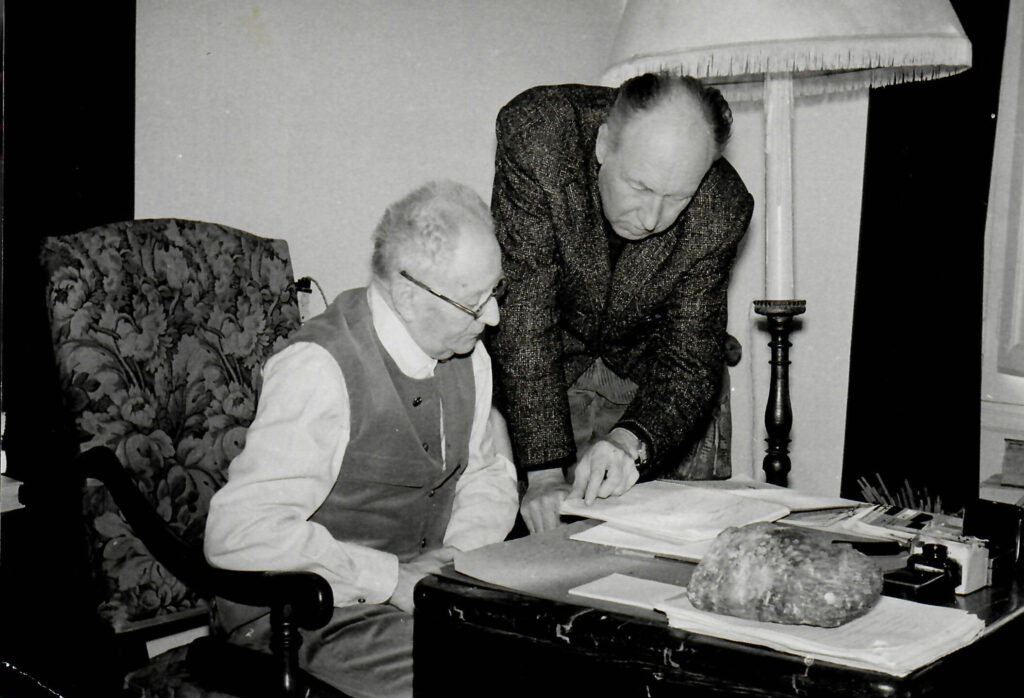
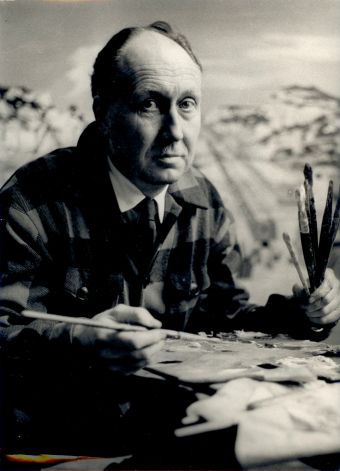
Biography
Yves Brayer, master of graphism and colour
Yves Brayer was among the painters who, between the two world wars, felt the need to engage with the reality around them. While rejecting—without ignoring—the pictorial movements of the late 19th and early 20th centuries, they saw themselves more as disciples of Vuillard and Bonnard, like the Poetic Reality group, or as admirers of Courbet, like the Forces Nouvelles movement. Although Brayer always remained independent, his friends included Francis Gruber, who was at the origin of French New Realism in the 1950s, of which Bernard Buffet would become a brilliant example.
Yves Brayer was born in Versailles in 1907, but he spent most of his childhood in Bourges. When he arrived in Paris in 1924, he attended the Montparnasse academies, then the École des Beaux-Arts. From a very young age, he showed his personality and was encouraged by elders such as Jean-Louis Forain. Still a student, he exhibited at the Salon d’Automne and the Salon des Indépendants. In 1927, a state travel grant enabled him to go to Spain, where his encounter with the masters of the Prado Museum would have a decisive influence on his future work. After a stay in Morocco thanks to a prize created by Marshal Lyautey, he won the Grand Prix de Rome in 1930. At first he missed Spain, then he was swept up by the richness of Italian life in the 1930s.
On his return to Paris in 1934, he brought together his harvest in a major exhibition at the Galerie Charpentier, Faubourg Saint-Honoré, where the public discovered the authenticity of this twenty-seven-year-old painter with a powerful and original temperament.
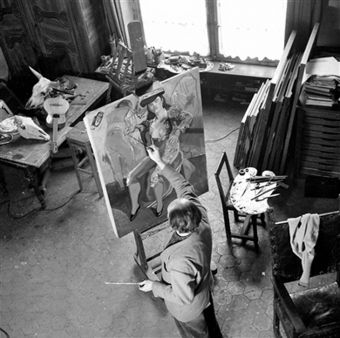
Paris remained his home port and, after living in the Panthéon district, he moved in 1936 to Rue Monsieur le Prince, in the 6th arrondissement. At various times, he painted in Paris, even while he was a student, between 1926 and 1929. Demobilised in Montauban, he settled in Cordes-sur-Ciel in the Tarn in 1940. A museum would be dedicated to him in the town hall’s finest room as early as 1960. In 1942, he returned to the capital, where Jacques Rouché asked him to design his first set and costume models for a ballet at the Paris Opera. He remained there during the Occupation and painted the snow-covered city, then the liberated city.
The year 1945 marked a new stage in his work. In Provence, he realised that there were harmonies other than those of man-made architecture—those of pure, wild nature—and he soon became fascinated by the diversity of the Alpilles and their limestone folds, then by the expanses of the Camargue populated by white horses and black bulls. He soon settled in Provence for several months each year.
After his Spanish black period, then his Italian ochre and red period, he broadened his palette by introducing greens, pale yellows and a few blues. Strongly drawn to Mediterranean landscapes, he returned to work in Spain and Italy, but Provence and the Camargue would remain his favourite places until the end of his life.
He undertook various journeys to Mexico, Egypt, Iran, Greece, Russia, the United States and Japan. Quickly capturing the light and rhythms of these countries, he brought back numerous drawings and watercolours.
His taste for graphic art naturally led him to practise copperplate engraving and lithography; he produced numerous prints and illustrated limited-edition books with texts by Blaise Cendrars, Henry de Montherlant, Baudelaire, Paul Claudel, Jean Giono, Frédéric Mistral, etc…
Yves Brayer also created mural decorations, tapestry cartoons, and set and costume models for the Théâtre-Français and the opera houses of Paris, Amsterdam, Nice, Lyon, Toulouse, Bordeaux and Avignon.
His solo exhibitions made his works familiar in many countries: first in Paris, then in France, Europe and the United States. In 1977, the Bibliothèque Nationale presented “Yves Brayer, Engraver” for his seventieth birthday, and the Musée Postal devoted an exhibition of his works to him when the stamp commissioned from him was issued in 1978. Lastly, the MUSÉE YVES BRAYER was inaugurated in September 1991 in Les Baux-de-Provence.
His work is held in various museums and in many collections both in France and abroad. He was a professor at the Académie de la Grande Chaumière for fifty years, President of the Salon d’Automne for five years and, as a member of the Académie des Beaux-Arts, curator of the Musée Marmottan – Claude Monet in Paris for more than eleven years.
Bibliography
Major monographs have been devoted to him by André CHAMSON, Pierre MAC ORLAN, Jean GIONO, Armand LANOUX, Pierre MAZARS, Roger PEYREFITTE and Yves DENTAN.
Main monographs
Jean BOURET, In Praise of Yves Brayer, Ed. Manuel Bruker, 1955
André CHAMSON, Yves Brayer, Ed. Pierre Cailler, 1958
Pierre MAC ORLAN, Yves Brayer and His Processions, Ed. Romanet, 1961
Jean GIONO, Yves Brayer, Bibliothèque des Arts, 1966 and 1971
Jacques GUIGNARD, Catalogue raisonné of Yves Brayer’s engraved work, Ed. Pierre Cailler, 1970
Marcel ZAHAR, Yves Brayer, Vision sur les Arts, 1974
Armand LANOUX,Yves Brayer, Ed. A. de Francony, 1977
Pierre MAZARS, Yves Brayer, Watercolours, Ides et Calendes, 1978
Roger PEYREFITTE, Greece, Our Mother, watercolours by Yves Brayer, Ed. Michèle Trinckvel, 1985
Yves BRAYER, Theatre Designer, Ed. Archimbaud, 1986
Georges OBERTI, Yves Brayer in Corsica, Collection of watercolours, Ed. Méditerranéennes du Prado, Marseille 1987
Jean-Robert DELAHAUT, Yves Brayer, Ed. Terre d’Europe, 1985 & Ed. Librairie Séguier, 1988 (English and French)
Jean GIONO and Yves DENTAN, Yves Brayer, reissue, Bibliothèque des Arts, 1990